
If you’re comparing custom spiral stairs to kit staircases, the differences go far beyond price. Installation time, long-term durability, appearance, and fit all affect how well a stair performs.
Working with a custom spiral stair manufacturer allows you to get a staircase designed specifically for your space rather than adapting your project to a standard kit.
Custom Iron has built spiral stairs in Zumbrota, Minnesota, for over 50 years. Every stair leaves the shop custom-built to your specs, pre-assembled and checked, then knocked down (disassembled) into manageable components for shipping.
When it arrives, it goes back together the way it came apart, with no surprises.
What You Get With Kit Spiral Stairs
When a company sells you a kit spiral stair, they’re pulling standard parts off a shelf and boxing them up. That’s it. You get what fits the shelf, not what fits your space.
The instructions that come with kit stairs often run 10 to 20 pages. You’ll need to measure, cut parts to length, drill holes, and form the handrail yourself. The handrail is often plastic tubing. After all that work, you might end up with a stair that sways when you walk on it and looks like something assembled in a garage, because it was.
Custom Iron’s instructions are two pages. Two people can have the stairs fully installed in about two hours. No cutting, no drilling, no forming. The handrail comes pre-formed and pre-fitted for your specific stairs. Metal, not plastic.
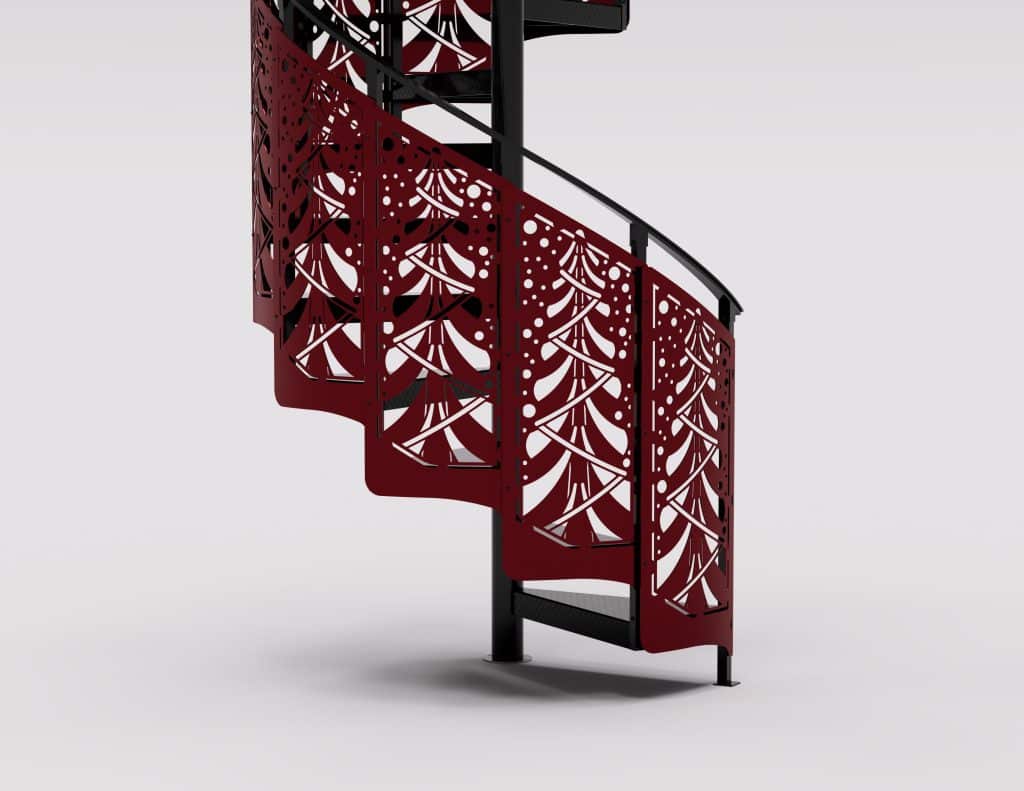
Custom Spiral Stairs Built for Your Project
Every Custom Iron spiral stair is built one at a time. That means the center column sleeves are custom cut, no measuring or adjusting required on your end. The mid balusters come pre-cut to the required length. Platform railing is included. Enclosed tread ends are standard across all models.
Compare that to most kit stairs, where the platform, railing, and balusters are either optional add-ons or cut-it-yourself components. What looks like a lower price up front often gets more expensive once you figure out what’s missing.
The team at Custom Iron builds spiral stairs to your specifications because a stair that doesn’t fit your space or your project isn’t much of a value at any price.
Custom Spiral Stairs vs Kit Spiral Stairs
| Feature | Custom Iron | Typical Kit Stair |
| Built to order | Yes | No |
| Pre-assembled and tested | Yes | No |
| Handrail included | Yes | Usually additional |
| Cutting required | No | Often |
| Drilling required | No | Often |
| Metal handrail | Yes | Often plastic |
| Installation time | Around 2 hours | Can take a full day or more |
| Exterior options | Yes | Limited |
Custom Spiral Stairs for Residential and Commercial Projects
These kinds of Custom Iron spiral stairs are used in a wide range of residential and commercial applications, including:
- Homes and lake cabins
- Lofts and garages
- Basements and additions
- Retail spaces
- Office buildings
- Industrial facilities
Because each stair is built to order, dimensions and configurations can be tailored to the needs of the project.
Custom Iron carries options across a real range of styles and budgets. The D100, known as Old Faithful, is a proven entry-level spiral stair that’s been a workhorse for decades.
If you want something with more flexibility, the D500 (The Expression) lets you change the look down the road. There are also Monobeam Stairs, railing systems, and fully custom builds for projects that don’t fit a standard category.
All models have options for exterior use, which many kit stair companies can’t say. Whatever your project, Custom Iron will work beside you to make it happen.
Why Choose a Custom Spiral Staircase
A custom spiral staircase is something you’re going to use every day. Take the time to invest in a staircase built specifically for your space rather than settling for one assembled from whatever happens to be in stock.
Custom Iron has been doing this for over five decades. The process is straightforward: you tell them what you need, they build it to those specs, and when it shows up at your door, it goes together quickly and without drama. That’s the whole promise.
Looking for a spiral staircase built specifically for your space?
Explore Custom Iron’s full line of spiral stairs or contact our team for a quote. We’ll help you find the right design, dimensions, and options for your project.
Spiral Stairs FAQs
What’s the difference between a Custom Iron spiral stair and a kit stair?
Custom Iron builds each stair to your specifications, pre-assembles it at the factory, then ships it knocked down for easier handling. Manufacturers ship kit stairs as standard components, leaving installers to handle significant cutting and drilling on-site.
How hard is it to install a Custom Iron spiral stair?
Most installs take two people about two hours. The instructions are two pages long. Handrail and balusters go in without drilling.
Does Custom Iron build stairs for outdoor use?
Yes. All Custom Iron models have options for exterior use, which isn’t the case with most kit stair manufacturers.
Why is the handrail important when comparing spiral stairs?
Many kit stair companies use plastic tubing for the handrail. Custom Iron never uses plastic tubing. The handrail is metal, pre-formed, and pre-fitted for your specific stair before it leaves the factory.
Can I get something more custom than a standard model?
Yes. Custom Iron works on custom projects beyond the standard lineup, including Monobeam Stairs and unique railing systems. If you have something specific in mind, they’ll talk it through with you.
How Much Space Does a Spiral Staircase Require?
The amount of space needed depends on the stair diameter, building codes, and how the staircase will be used. Most residential spiral staircases require a footprint between 5 and 7 feet in diameter, although compact models can fit into smaller spaces. Custom Iron builds every spiral stair to order, allowing us to customize the dimensions for your project while meeting applicable code requirements and providing comfortable everyday use.
Are custom spiral stairs more expensive than kit stairs?
Custom spiral stairs typically cost more upfront because manufacturers build them specifically for your project.However, many property owners find the added value in faster installation, better fit, improved durability, and included components that are often extra-cost options with kit stair systems.